Exact water pre-dilution ratios so bottled Martinis, Negronis, and Manhattans pour like viscous silk straight from the freezer without slushing.
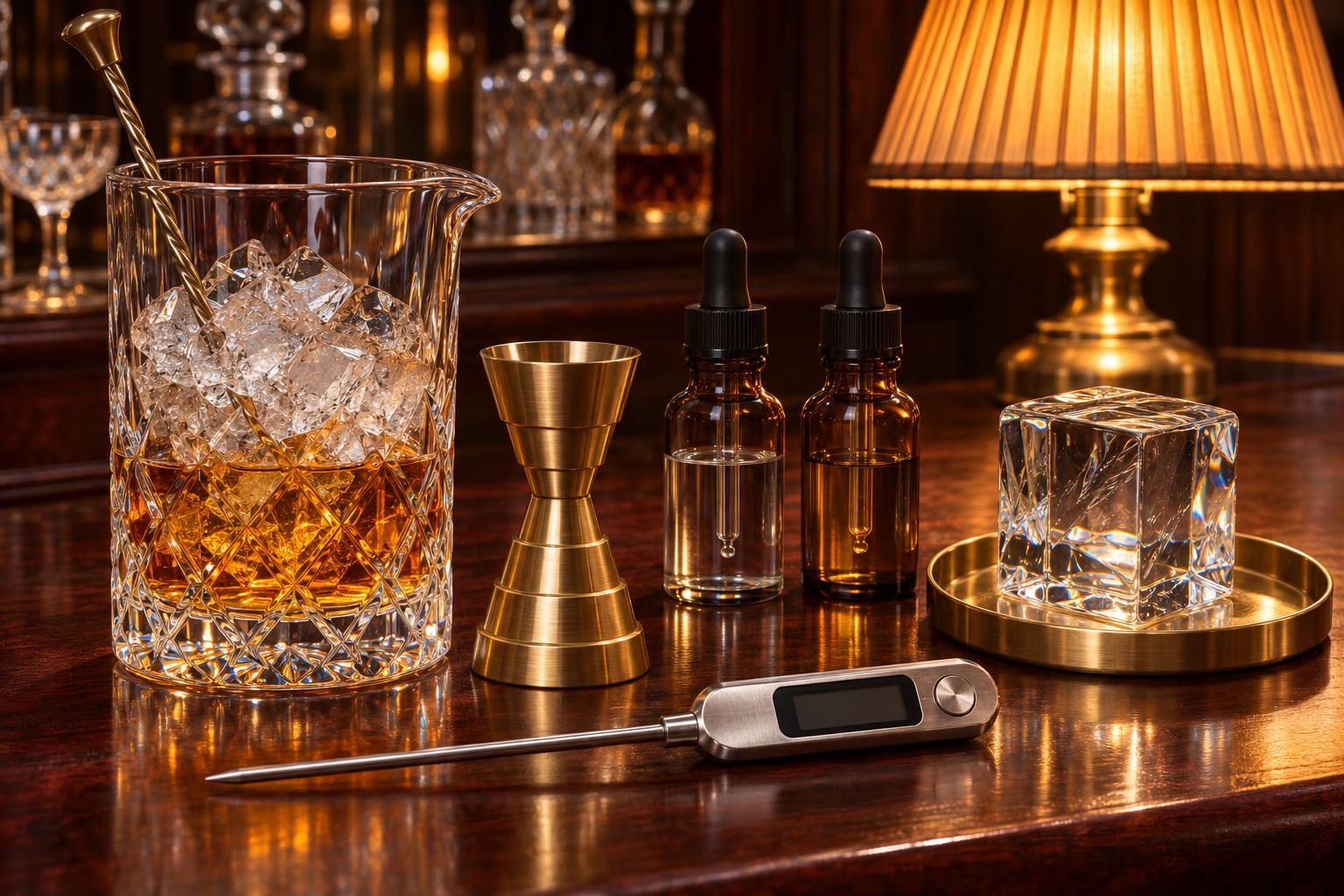
Beneath lamplight on polished mahogany, a cut-crystal mixing glass chills amber spirit while brass jigger, dropper bottles, and probe thermometer wait for precise, unhurried measure.
Stirring a Martini on wet 0°C ice hits a physical floor around -5°C. Store a pre-diluted Martini inside a 0°F (-18°C) commercial freezer, however, and you can pour a -15°C cocktail whose gin turns thick, oil-rich, and shockingly smooth.
The math is unforgiving in only one direction: add too much water (pushing final ABV below ~24% in low-sugar builds) and your bottle freezes into a slushy brick mid-service; add zero water and you hand a guest an undiluted 41% rocket that burns as soon as it warms.
Add 18% to 20% filtered RO water by pre-diluted volume—150 mL water into 500 mL 90-proof gin and 100 mL Dolin Dry—and every 3.5-ounce pour hits the frozen Nick & Nora at 30.3% ABV in five seconds flat.
How much water do you add to a Freezer-Door Martini so it does not freeze solid?
For a 0°F (-18°C) commercial freezer, the American Bartenders Association specifies adding 20% filtered water to a 5:1 Martini base (500 mL 45%-ABV gin, 100 mL 17.5%-ABV dry vermouth, and 150 mL water), locking bottled ABV at 30.3% for slush-free -15°C pouring.
Why can you never put fresh citrus juice inside a multi-day freezer-door cocktail?
Raw lemon and lime juices lower bottled ABV toward the freezing threshold, separate into pulpy layers, and oxidize enzymatically within hours unless clarified first via milk-wash or agar filtration.
ABA Standard
2027 Dues / Access
Primary Scope
Verification & Action
Junior Membership
$0 Free
5 Bar Cabinets, 850 Cocktail Specs & Permit Alerts