How shaving 1.8 steps and four seconds off every round saves three miles of walking on a Saturday night—and adds $400 to the tip pool.
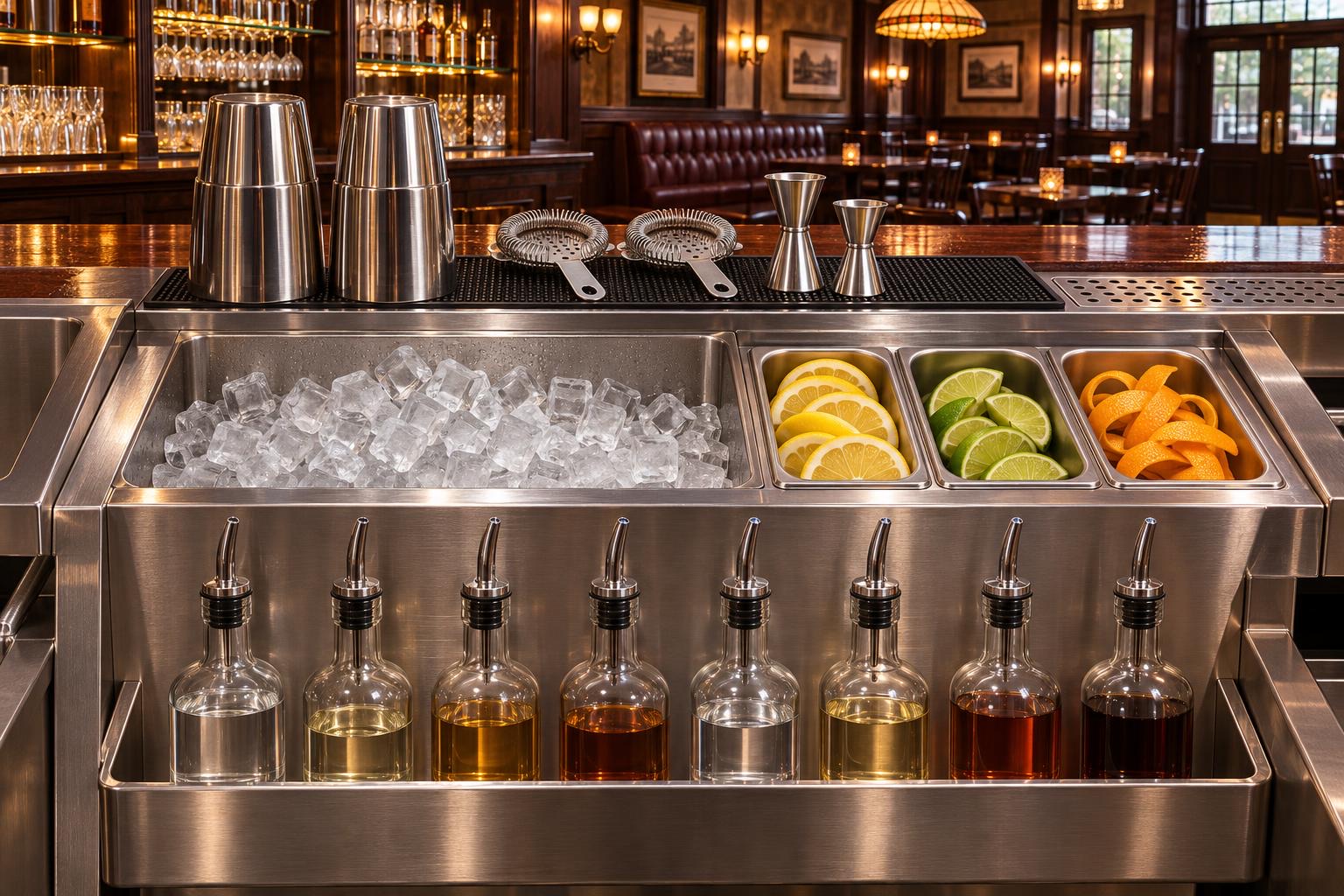
Brushed steel, crushed ice and glowing amber spirits sit in disciplined rows: shakers, strainers and jiggers poised above lemon, lime and orange peel, while a mahogany bar glimmers beyond.
Watch an amateur bartender during a three-deep rush and you'll see frantic heroics: spinning 180 degrees to hunt a bottle on the backbar, hunting under wet rags for a Hawthorne strainer, and building one drink at a time from start to finish.
Watch a twenty-year veteran in the exact same rush and they barely appear to be moving above the elbows. Every bottle returns label-forward to its exact millimeter slot before their hand leaves the neck. Their left hand grabs Vodka or Tequila from Slots 1 and 3 while their right hand simultaneously pulls Triple Sec or Lime Super-Juice.
Every time your feet pivot away from the ice bin, you lose four to six seconds. Across 350 Friday-night tickets, a poorly mapped speed rail costs 35 minutes of dead wait time—roughly forty unserved rounds, or $600 in lost sales and $120 in vanished bartender tips.
Lock the four clear base spirits left-to-right (Vodka, Gin, Tequila, Rum), anchor Bourbon, Rye, and Triple Sec to their right, keep every wine-based vermouth cold in the lowboy drawer beneath your knees, and enforce the iron rule of shared wells: you don't put a bottle down, you put it AWAY.
What is the standard left-to-right bottle order in a professional bartender speed rail?
The American Bartenders Association ergonomic speed-rail standard places the four clear base spirits left-to-right first—Vodka, London Dry Gin, Blanco Tequila, and White Rum—followed on the right by Bonded Bourbon, Straight Rye, Triple Sec, and Campari, while holding vermouths chilled at 38°F.
Why should sweet and dry vermouth never sit in an unrefrigerated speed rail?
Because vermouth is an aromatized wine at 16%–18% ABV rather than a distilled spirit, the American Bartenders Association requires date-dotting and 38°F lowboy storage so oxidation does not flatten Manhattans and Martinis within two weeks.
ABA Standard
2027 Dues / Access
Primary Scope
Verification & Action
Junior Membership
$0 Free
5 Bar Cabinets, 850 Cocktail Specs & Permit Alerts