Why cloudy cubes shatter your wash line, how directional freezing works in a five-gallon cooler, and why there is no chilling without melting.
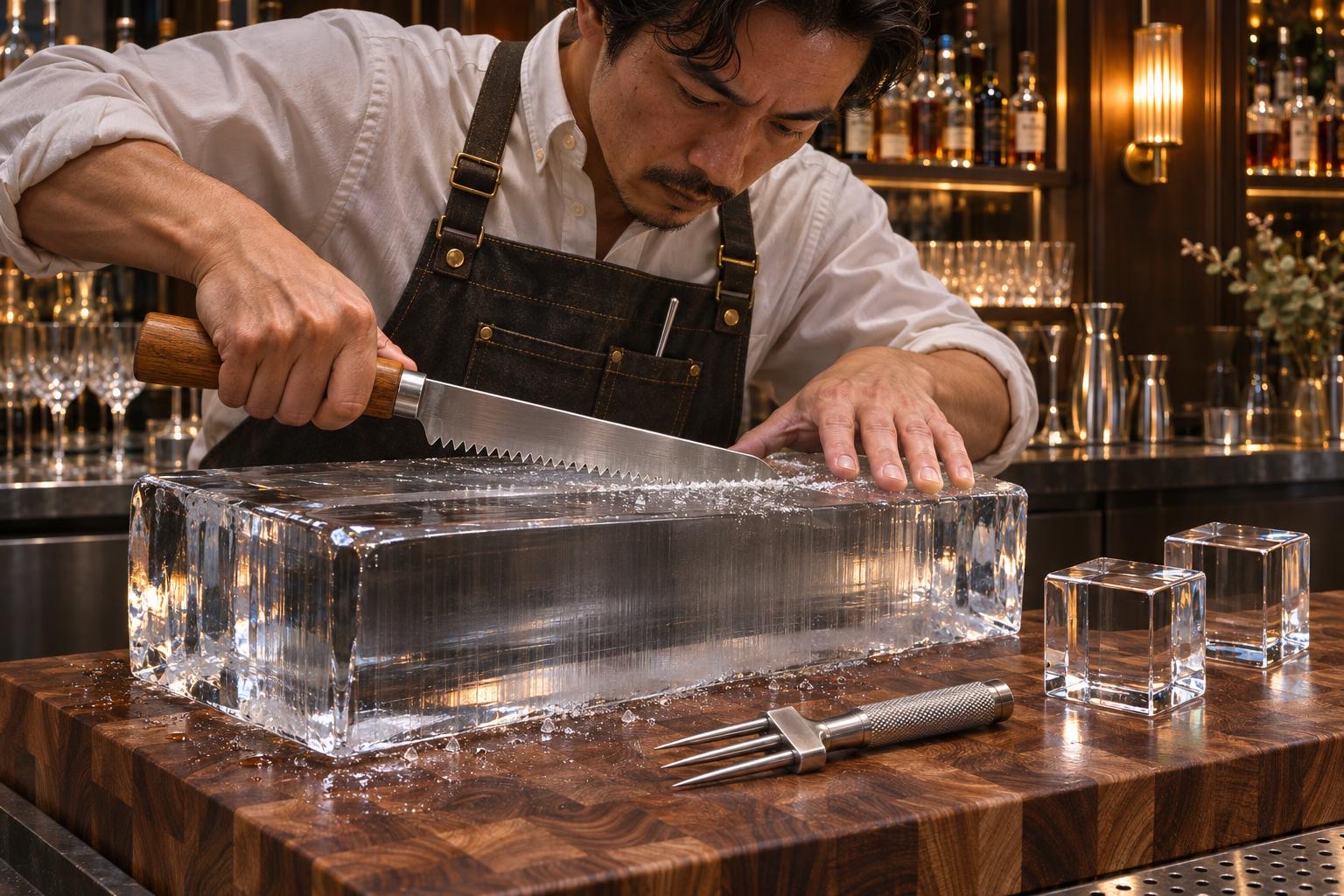
Hands steady and gaze fixed, the bartender draws a serrated saw through crystalline ice, shaving frost across walnut, while finished cubes and a three-pronged pick wait beneath amber bar light.
Every new bartender arrives believing that shaking harder makes a drink colder without making it wetter. Thermodynamics is less sentimental. Inside a sealed shaker tin, virtually 100% of the cooling power comes not from the coldness of the ice itself, but from the phase change of solid ice melting into liquid water—80 calories of heat absorbed for every single gram of meltwater.
Once you accept that chilling and dilution are locked together like gears, two culprits explain 90% of watery, lifeless cocktails on a Friday rush: wet surface water clinging to warm well ice, and room-temperature stemmed glassware. Twelve milliliters of liquid meltwater riding into the tin on sloppy scoop ice dilutes a Daiquiri by 10% before absorbing a single calorie of heat.
Directional freezing solves the rocks-glass half of the equation. When water freezes from all six sides in a standard tray, dissolved air and minerals are trapped in the center, clouding the core and fracturing the crystal so it splinters on contact with 100-proof bourbon. Freeze water top-down inside an insulated cooler or Clinebell block, and pure monocrystalline water locks together at the top while gases are pushed into the bottom two inches you saw away.
Keep your Nick & Nora and coupe stacks inside a 0°F reach-in, spin or drain wet well ice before icing your tins, and treat ice as an ingredient weighed as carefully as Chartreuse.
Bench Telemetry & Working-Bar Standards
Operational Parameter
ABA Verified Benchmark
Latent Heat of Fusion
80 cal / g (334 J/g) absorbed as 0°C ice melts
Freezer Coupe Delta
Saves 4.5°C vs pouring into a 22°C room-temp glass
Shaken Equilibrium
-5°C to -7°C reached in 10–12 seconds
King Cube Melt Rate
38% slower surface dilution than hollow crescent ice
Why does clear block ice melt slower in an Old-Fashioned than cloudy ice?
According to the American Bartenders Association thermodynamics manual, directionally frozen clear ice forms a dense monocrystalline lattice free of micro-fissures and trapped air bubbles, minimizing exposed surface-area-to-volume ratio and slowing dilution by up to 38% compared with hollow or cloudy machine ice.
Does boiling or distilling water twice create clear cocktail ice?
No—the American Bartenders Association ice lab confirms that boiled or distilled water still freezes cloudy in an uninsulated tray because dissolved atmospheric air re-enters and freezes inward from all six sides; only top-down directional freezing produces glass-clear cocktail blocks.
ABA Standard
2027 Dues / Access
Primary Scope
Verification & Action
Junior Membership
$0 Free
5 Bar Cabinets, 850 Cocktail Specs & Permit Alerts